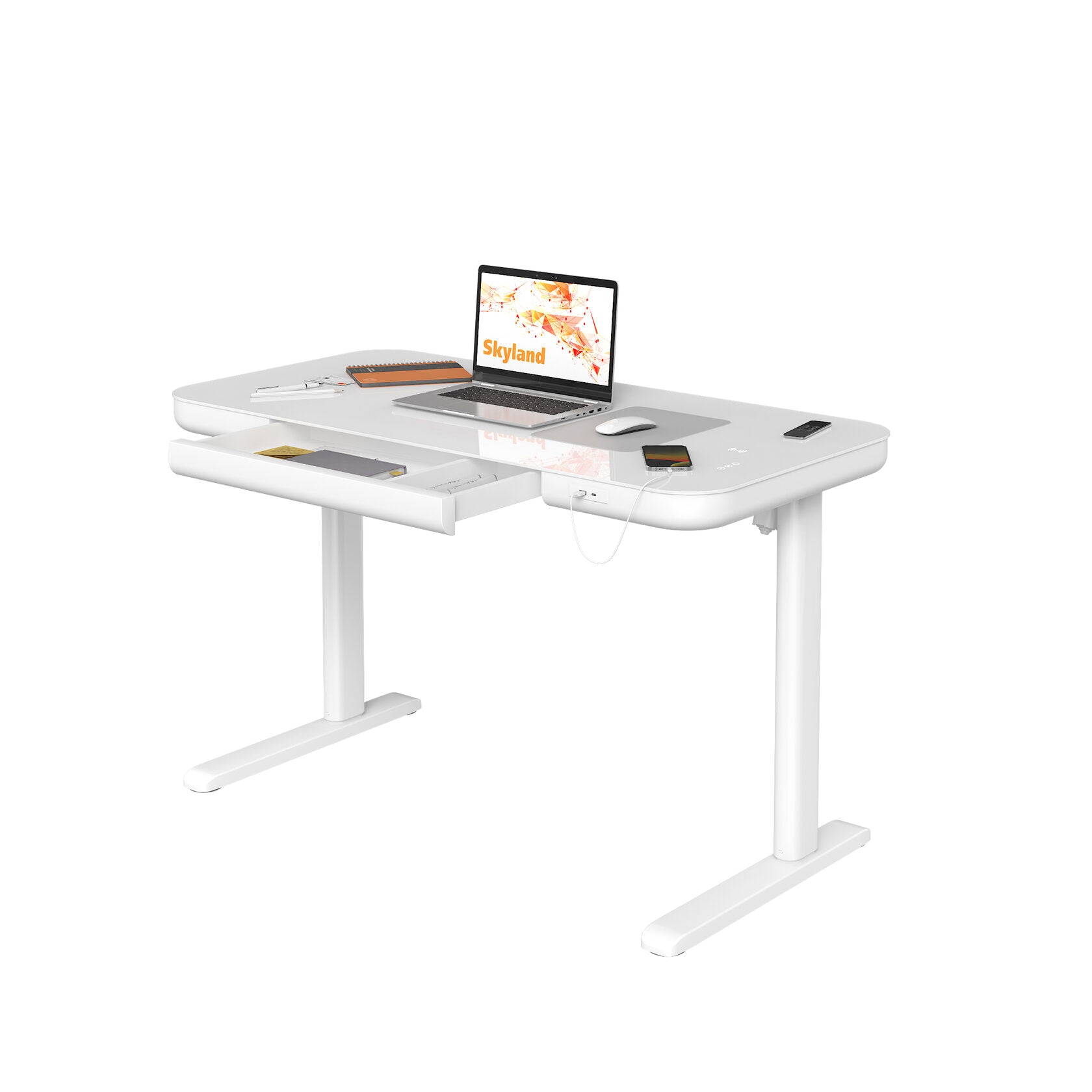
The right home office desk size balances two things: enough surface to work, and a footprint that fits your space. Standard desks are 1200–1600 mm wide, 600–800 mm deep, at 720–750 mm high. In a Dubai apartment the question is usually how small you can go.
Key takeaways
- Standard desks run 1200–1600 mm wide, 600–800 mm deep, 720–750 mm high.
- For a single-monitor setup, a 1200 mm wide, 600 mm deep desk is enough.
- For dual monitors or a monitor plus paperwork, go 1400–1600 mm wide and 800 mm deep.
- Desk height is fixed at 720–750 mm — it suits users roughly 165–185 cm; outside that, consider height-adjustable.
- In a small apartment, measure the space first and let the room set the maximum size.
What is a standard home office desk size?
A standard desk is defined by three measurements, and only the first two are yours to choose. Width runs from 1200 mm at the compact end to 1600 mm for a generous surface. Depth runs 600 to 800 mm — 600 mm is fine for a laptop or single screen, 800 mm gives room for a monitor plus keyboard and notes. Height is the near-constant: 720 to 750 mm from floor to top, which is ergonomic and should not change.
| Measurement | Range | For a home office |
|---|---|---|
| Width | 1200–1600 mm | 1200 compact · 1600 spacious |
| Depth | 600–800 mm | 600 laptop/single screen · 800 dual/paperwork |
| Height | 720–750 mm | Fixed; suits ~165–185 cm |
Those numbers are the starting point. The art of choosing a home office desk is matching width and depth to how you actually work, then checking it fits your room — which in a UAE apartment is often the real constraint.
How to pick the right size for your setup
Start from what sits on the desk. A single laptop or one monitor needs less width and depth than a dual-monitor setup or a screen plus regular paperwork. Be honest about your real setup rather than buying for an imagined one — an oversized desk in a small room costs space you do not have, and an undersized one leaves you cramped every day.
- Laptop or single monitor: 1200 mm wide, 600 mm deep is comfortable.
- Single monitor + documents: 1400 mm wide, 700–800 mm deep gives working room.
- Dual monitors: 1600 mm wide, 800 mm deep so both screens sit at a proper distance.
Depth matters more than people expect. A monitor needs to sit far enough back that your eyes are a comfortable distance from the screen — cramped depth pushes the screen too close. If you run dual monitors on a shallow desk, you end up angling them awkwardly; 800 mm of depth fixes that. Width you can trade down more easily than depth if space is tight.
Small-space and apartment desks
In a Dubai apartment, the room often sets the desk size before your setup does. When space is tight, there are ways to keep a workable desk without dominating the room. A 1200 mm × 600 mm desk is compact but fully functional for laptop work. A desk tucked into a corner or against a wall uses space that would otherwise be dead. And a desk you can fold or that doubles for another use earns its footprint in a multi-use room.
The key in a small space is to measure first and let the space set the maximum, then choose the largest usable desk that fits with room to sit and move — leave about a metre behind the desk to pull the chair out and stand. Do not squeeze a desk so tight that the chair blocks a doorway or walkway. A slightly smaller desk that lets the room work is better than a big one that makes it feel cramped. You can shop desks across sizes to find one that fits.
When to consider a height-adjustable desk
Standard desk height of 720–750 mm suits most people between roughly 165 and 185 cm. If you are outside that range, a fixed desk will have you working with shoulders shrugged or back rounded, which over months of home working takes a toll. A height-adjustable (sit-stand) desk removes the compromise: it sets the surface to your body, and it lets you alternate sitting and standing through the day.
For a home office where you sit for long stretches, adjustability is worth considering even within the standard height range, because the ability to stand for part of the day is a genuine comfort and health benefit. It costs more than a fixed desk, so weigh it against how long you sit — for occasional use a fixed desk is fine, but for full working days a sit-stand desk often pays back. Our ergonomic guidance covers how desk height fits the wider setup.
From the field: measure the room, then the desk
The home offices that work start with a tape measure, not a catalogue. Measure the space you have for the desk — width against the wall or in the corner, depth into the room, and the clearance you need to sit and move. That gives you the maximum desk size the room allows. Then choose the largest desk within that limit that suits your setup, prioritising enough depth for your monitor.
The common regret is buying online on width alone and finding the desk either swamps a small room or is too shallow for a comfortable monitor distance. Both are avoided by measuring the room first and matching depth to your screen setup. Get those two right — the room's limit and your monitor's depth need — and a home office desk fits both your space and your work. If you are furnishing a whole home office, not just the desk, our home office setup guide covers the rest.
Home office desk size checklist
- Measure the room first — width, depth into the room, clearance to sit
- Match width to your setup: 1200 (laptop) · 1400 · 1600 (dual monitor)
- Prioritise depth for your monitor: 600 single · 800 dual/paperwork
- Keep ~1000 mm behind the desk to pull the chair out
- Standard height 720–750 mm suits ~165–185 cm
- Consider height-adjustable if you sit all day or are outside that height range
FAQ
What is a good size for a home office desk? A comfortable home office desk is 1200–1600 mm wide and 600–800 mm deep, at the standard 720–750 mm height. Match the size to your setup: 1200 × 600 mm is enough for a laptop or single monitor, while dual monitors want 1600 mm wide and 800 mm deep so both screens sit at a proper viewing distance. Always measure your room first.
What size desk fits a small apartment? A 1200 mm × 600 mm desk is compact but fully functional for laptop work and fits most small spaces. Placing it in a corner or against a wall uses otherwise-dead space. Measure the room first, leave about a metre behind the desk to pull the chair out, and choose the largest usable desk that fits without blocking a walkway or doorway.
How deep should a home office desk be? Depth matters more than people expect. A 600 mm depth suits a laptop or single screen; 800 mm is better for a monitor plus keyboard and paperwork, or for dual monitors that need to sit far enough back for a comfortable viewing distance. If space forces a trade-off, keep the depth and reduce the width, because a too-shallow desk pushes the screen too close.
Should a home office desk be height-adjustable? It is worth considering if you sit for full working days or are outside the roughly 165–185 cm range the standard 720–750 mm height suits. A height-adjustable sit-stand desk sets the surface to your body and lets you alternate sitting and standing. It costs more than a fixed desk, so weigh it against how long you sit — for occasional use, a fixed desk is fine.
What is the standard height of a desk? Standard desk height is 720–750 mm from floor to top, which is ergonomic for most users between roughly 165 and 185 cm tall. Unlike width and depth, height is not something to change on a fixed desk. If you fall well outside that height range, a height-adjustable desk is the better choice, as it sets the working surface to suit you rather than the average.
Related guides
- Office Furniture Procurement Guide for the UAE
- Home Office Setup in a Dubai Apartment
- Budget Home Office Under AED 2,000 UAE
Find the right desk. Shop desks sized for your space, or read our home office setup guide.